Sunday, October 25, 2009

Happy Origami International Day!


I didn't know there was an International Day of Origami. It was born as an iniciative of the north american group Origami USA, altogether with the British Origami Society. In Japan there is already a conmemmorative day, November 11th, the day when the traditional paper crane became an official symbol of peace. It was thought then to use it, but Alas! in english-speaker societies that date is War Veteran's Day (Origami doesn't lack of irony, I guess).

It was chosen then October 24th, birth date of Lillian Oppenheimer (1898-1992), founder in 1958 of the first Origami group in America: FOCA ("Friends of Origami Center of America", which was going to become Origami USA), besides her, the group included also Isao Honda from Japan and Robert Harpin from England; she was later founder member of the British Origamy Society in 1967.

In South America the oldest references we found them in Dr. Vicente Solorzano Sagredo (founder of the Argentinean Origami Museum in 1954, closed on 1961), Ligia Montoya and Adolfo Cerceda (Argentina).


Due to her enthusiasm and vitality promoting this art, Lillian Oppenheimer is considered the tru "mother" of western origami. However to me this date still doesn't look too wide world consent taking in consideration Eastern Europe, Africa or Central and South America. It is reasonable for me to take November 11th (with the bow of the Veterans), since it is also a date related to peace and Art, to the bottom line, is an act of communication and understanding between people.

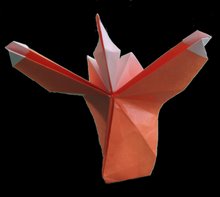
The propposal then is to celebrate from Oct 24th to Nov 11th the International Days of Origami. So, joining it I thought to tape and share a new set of videos, to fold the beautifull horse from japanese Noboru Mijayima, its diagram is available on his website. I hope you enjoy folding it :D


I send a massive hug to all origamists in the world and specially to the brave ones who try it for the first time!

reference:
http://www.britishorigami.info/academic/temko_memoirs.php

Wednesday, August 05, 2009

Valparaiso 2009 World Peace Cry


A year passed. An intense year. Suddenly is August, and our Annual Convention has become into a reality in the beautiful and historic port of Valparaiso. Tomorrow begins a new party with friends, a great exhibition, workshops, laughs and challenges. And it begins in the best way, with a calling for peace and the end of wars in the world.

In August 6 we remember the falling of the first atomic bomb used in war in Hiroshima on 1945, killing 120 thousand people and contaminating by radiation more than 300 thousand more... On this date all around the globe, people meets to hang simbolically paper cranes to demand their authorities the end of wars and World Peace, as the way for the future of mankind, following the example of an 11 years old girl called Sadako Sasaki, who wanted to fold 1000 cranes of paper to ask for the victims of the war and saddly died without achieving it, due to the radiation on 1955.

This Thursday we will hang thousands of cranes on an act inscribed on the World March for Peace and No Violence action. The act will be at 12:00 hrs on the square of the British Arc on Brasil Avenue, Valparaíso-Chile. If you want to join it and fold your crane, here I left the instructions, it's very simple and beautiful and we hope each one of them is a step for a the only future possible.


Here is also a map to reach the act


Friday, May 08, 2009

Between the Folds of Life


Last week we had an unexpected and motivating encounter. Passing by Chile was a member of the Spanish Origami Association, Olga de Pedro, a fantastic, enthusiastic and funny person. she sent us a last-minute mail and some of us that could get off job went to met her at her Hotel the last day she was on Santiago. In her and her husband's eyes and talk you could see they were coming from an astonishing travel, through the glaciers and ices of the Aysen region, the Patagonian steppes of the end's world and the singular deserts of Atacama. And we seat to talk about origami... sharing experiences, introduce ourselves, tell her about our group, the activities we have done, possible travels and realities.

Sudden we were, as Olga said, putting faces to the names, to what is written on forums or web sites; I felt stronger than ever, the need of an Spanish-talking magazine, that circulates and be read in Spain and America, to have a closer community, to see us and recognize the friends in news from Colombia, Nicaragua, Peru, Zaragoza, Burgos or Madrid. Also last week we had on Origami Chile's anniversary a video conference with friends in Colombia and it was exciting, was like to seat all of us in the same living room and be part of the same meeting, as one big group of friends...

Travels and visits are essentials but, between them, to fill the emptiness of missing the friends, to know what are they doing, what are they folding , what new models have they created, it is necessary to have a publication, where to announce of conventions and projects, where to propone theory and introduce the new young talents. Internet is a good platform, but nothing compares to a magazine, made of paper, to carry it on the bag, to read it with love and to pass the pages, releasing the secrets of every new turn of them.

The idea we have discussed it many times, important creators has showed us their enthusiasm of participate on it. That were what I was thinking drinking my beer, when I founded a little piece of paper hidden on the pages f the book that Olga was carrying, I took it instinctively and I began to fold.

Wednesday, January 14, 2009

Pasquale D'Auria Swan


World is a complex place, so complex that it gives its space to simplicity. In the course of a life it gives us thousands of simple but powerful moments: a laugh, a smart answer, the instantaneous pleasure of a music that makes everything fits its place on sense and purpose. I dare to think, at least for myself, that in them lies much more happiness than in the elaborated plans we make for living. Among the numerous free figures that can be found on the internet, most are simple and their diagrams rarely goes over the 30-40 steps, and therefore they are a fascinating source to find these amazing models full of beauty, aesthetic sense and elegance. Some months ago I showed one of these figures, the squirrel from american Perry Bailey, and now I do the same with this incredible swan, which diagram can be found on the Spanish Origami Association website.


One of its best characteristics is its three dimensional volume, something that is never considered when evaluating origami but that for me is a vital consideration since we live in a world beyond photography or diagram. Models that look ok only from certain angles, or that have ugly multilayered sides. This Swan, in the other hand, apart from the empty shell that lies below it, shows a perfect and gorgeous swan about to flight. The author is the italian Pasquale D’Auria and it also challenges us to fold its curved surfaces and elegance. It has became one of my favorites and I invite you all, fiercely, to fold it, to love it, and to give it as a miracle.


Wednesday, November 12, 2008

God Save the Square

My good friend Padyta asked me if it was possible to obtain a rectangular angle from an arbitrary piece of paper. If we remember that a square is possible to be constructed from that angle, her question have a great importance.

To build a perpendicular line to a given one in two-dimension geometry demands the use of ruler and compass and it is not an easy thing. One way is tracing a circumference of an arbitrary radius, centered in an starting point A, then a second circumference centered on the intersection of the line and the first circumference (point B), the intersection of both circumferences gives us a point C, equidistant to both corners A and B, a new circumference of the same radius centered on C and its intersection with the first circumference gives us a point D and finally the intersection of a circumference centered on D with the one centered on C gives us the point E, perpendicular to the line AB.


However, the "origeometry" allows us to use the paper itself and gives us a third dimension and increas our capabilities. So, if we have a given straight line, folding the paper aligning the line on itself we can get a perpendicular line.


Now that we have our rectangular angle, is it possible to construct a perfect square from it? The answer, luckily, it's a yes. Here it comes a way.

First you need to fold a 45° line between both lines, that will allow us to find the main diagonal passing through the next corner of the square. To do it, we fold aligning both lines on their intersecton point.


Then we align the small diagonal on itself folding a diagonal that passes over the corner of the square. A good choice of that corner will allow us to optimize the use of the paper to get the biggest size possible.


We can cut the main angle and the sides of the square. As we saw on the previous post we can obtain the opposite angle and complete the square by folding the main diagonal aligning it on itself, passing through the original corner.


It's pendant to btain a method to optimize the size of the obtained square, maximizing its area on the given paper. Many regards.

Monday, October 27, 2008

Our friend the Square


Since traditional Origami works over a perfectly squared piece of paper, the issue of obtaining it has become one of the greatest importance. How many of us has coursed to the heavens when we realize that our "special for origami" sheet is nor even a rectangle but a totally irregullar quadrilateral figure?

Through the years I've used diferent methods to "square" this sheets, with varied results; for example if the sheet is a regullar rectangle you can fold the bisector of one of the corners, this is one of the main diagonals, the intersection of it with the opposite side will determine the other corner of the square.


There is also the case of a long sheet came from a roll of paper, where you know that two opposite sides are perfectly parallel, then it's only necessary to fold a median perpendicular to both edges alining them, and then cutting both layers in a distance equals to half the height of the sheet, as is showed below; of course you will need a good graduated rule for this.


However, these methods fail when our sheet is an irregullar quadrilateral, like the fellow in the heading of this post.

To find a safe way to rescue the hidden square of our paper I went back to the teachings of my old Math's school professor (Carlos "the lizard" Zuñiga): "to construct a geometrical figure go back to the characteristic that defines it, the one that give it the being..." in this case, the 90° angles of its corners. The idea then is to inscribe a rectangular angle on one of their corners with a set square (or the corner of a copy machine sheet of paper)


we cut this angle. Over it you can fold the main diagonal, aligning one side on the other, this diagonal will be our future simmetry axis.


Then, to construct the second diagonal, we reflects the rectangular angle on the opposite side by folding in the closer adyacent corner and aligning the simmetry axis over itself, obtaining in that way a perfectly inscribed square to be cutted.


Finally to remark that if you use one of the side to inscribe the first rectangular angle you save one of the cuttings.


I hope it works for you all ;) many regards


Wednesday, July 30, 2008

This is our Cry, this is our Pray: Peace in the World!


Once in a while I think about the amount of time and energy I spend on this activity, and even when I repeat to me that this is not merely a hobby but a form of art, I can't free my mind of considering how much of selfishness or personal satisfaction moves me to do it, how much of self discipline, hard work and dedication, instead of a more social perspective, oriented to others. Maybe to compensate that in a way we participate on workshops, teaching the basics figures spreading this craft as alternatives of fun, education and discipline.


A year ago, my good friend Meri Affrachino told me about Sadako Sasaki. At the age of two she was one more of the inhabitants of the Japanese city of Hiroshima, which suffered on August 6th that year the apocalyptic destruction of the first atomic bomb dropped by USA over a civilian target. That day more than 120.000 persons died instantly, and 300.000 more received serious injuries and high dozes of radiation; 3 days after, other 140.000 died on the falling of a second bomb in the city of Nagasaki, right in the middle of the city, far away from its target (close Mitsubishi factory). Sadako lived normally and healthfully until 11, when she developed leukemia, due to her expose to radiation; this terrible decease consumed her very fast, bringing her to life in bed at the Hospital. There she learn about the legend of the 1.000 paper cranes.


Tells the legend about a deadly sick man who made 1.000 traditional origami cranes, to honor the sacred bird, famous because its longevity and purity. In appreciation for that it gave him health and a long life. Then tradition says sick persons that fold this number can ask for the wish of recovery, health and a long life. As a way to keep her hope of healing and be able for running again, she devoted herself to fold them with any piece of paper that she could get on the Hospital and soon she decided to ask for the other victims of the war and for World Peace also. Unfortunately she died on October 25th 1955, after 14 months of
sickness, she made 644 cranes.

It is told that her friends at school completed the remaining 356 and left all the 1.000 with her on her grave. Since then, every August 6th, thousands of people gather to fold and hang cranes in memory of little Sadako and to claim for Peace and the end of War in the world.

To us who practices origami, to fold a traditional crane becomes a very simple and maybe trivial thing; however, to leave this example and call unattended is simply a sin, out of any logic or behavior. In our continent, in the city of Rosario, Argentina, thanks to tireless Meri and her group, since 9 years they gather and hang cranes remembering Sadako and asking for peace, last year they reached more than 20.000 colorful cranes!

This year, here on Santiago (Chile), this Saturday August 2nd, we will do also, the meeting will be on Plaza Mori, Bellavista, at midday, to remember the cry written on Sadako's Memorial on 1958:

“This is our Cry, this is our Pray: Peace in the World!”

I hope to join my friend on Rosario this year and help her in any way I can.


Links:
Call: Mil Grullas por la Paz Santiago, Chile, 2 de Agosto (Facebook).
Project: Mil Grullas Por la Paz Rosario Argentina, 6 de Agosto
Project: Sadako.com
How to make an Origami Traditional Crane