Wednesday, July 30, 2008

This is our Cry, this is our Pray: Peace in the World!


Once in a while I think about the amount of time and energy I spend on this activity, and even when I repeat to me that this is not merely a hobby but a form of art, I can't free my mind of considering how much of selfishness or personal satisfaction moves me to do it, how much of self discipline, hard work and dedication, instead of a more social perspective, oriented to others. Maybe to compensate that in a way we participate on workshops, teaching the basics figures spreading this craft as alternatives of fun, education and discipline.


A year ago, my good friend Meri Affrachino told me about Sadako Sasaki. At the age of two she was one more of the inhabitants of the Japanese city of Hiroshima, which suffered on August 6th that year the apocalyptic destruction of the first atomic bomb dropped by USA over a civilian target. That day more than 120.000 persons died instantly, and 300.000 more received serious injuries and high dozes of radiation; 3 days after, other 140.000 died on the falling of a second bomb in the city of Nagasaki, right in the middle of the city, far away from its target (close Mitsubishi factory). Sadako lived normally and healthfully until 11, when she developed leukemia, due to her expose to radiation; this terrible decease consumed her very fast, bringing her to life in bed at the Hospital. There she learn about the legend of the 1.000 paper cranes.


Tells the legend about a deadly sick man who made 1.000 traditional origami cranes, to honor the sacred bird, famous because its longevity and purity. In appreciation for that it gave him health and a long life. Then tradition says sick persons that fold this number can ask for the wish of recovery, health and a long life. As a way to keep her hope of healing and be able for running again, she devoted herself to fold them with any piece of paper that she could get on the Hospital and soon she decided to ask for the other victims of the war and for World Peace also. Unfortunately she died on October 25th 1955, after 14 months of
sickness, she made 644 cranes.

It is told that her friends at school completed the remaining 356 and left all the 1.000 with her on her grave. Since then, every August 6th, thousands of people gather to fold and hang cranes in memory of little Sadako and to claim for Peace and the end of War in the world.

To us who practices origami, to fold a traditional crane becomes a very simple and maybe trivial thing; however, to leave this example and call unattended is simply a sin, out of any logic or behavior. In our continent, in the city of Rosario, Argentina, thanks to tireless Meri and her group, since 9 years they gather and hang cranes remembering Sadako and asking for peace, last year they reached more than 20.000 colorful cranes!

This year, here on Santiago (Chile), this Saturday August 2nd, we will do also, the meeting will be on Plaza Mori, Bellavista, at midday, to remember the cry written on Sadako's Memorial on 1958:

“This is our Cry, this is our Pray: Peace in the World!”

I hope to join my friend on Rosario this year and help her in any way I can.


Links:
Call: Mil Grullas por la Paz Santiago, Chile, 2 de Agosto (Facebook).
Project: Mil Grullas Por la Paz Rosario Argentina, 6 de Agosto
Project: Sadako.com
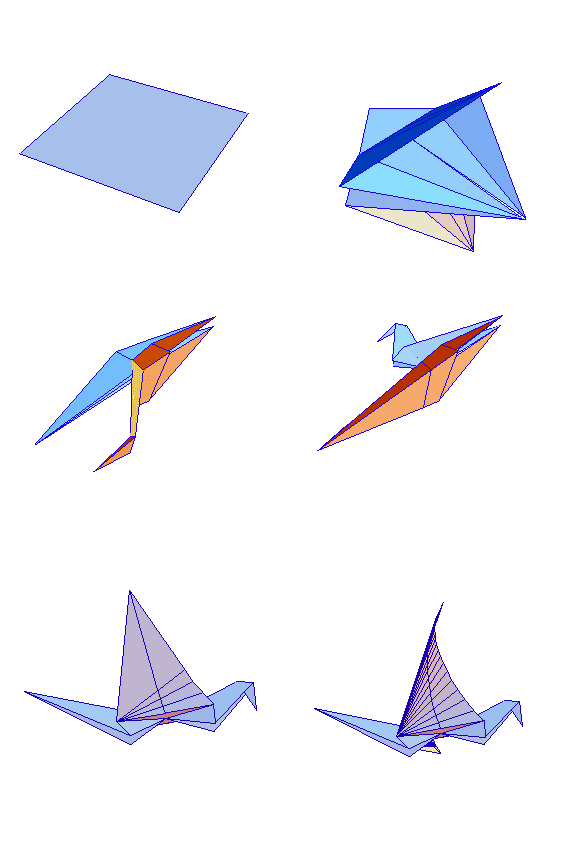
How to make an Origami Traditional Crane


Sunday, May 25, 2008

The Haga Theorems (Part I)


Months ago, when I get envolved with Robert Lang's Miura Ken Rose I got the courage of writing him an email, to show him my humble solution of its CP (now its diagram was published on Origami USA 2007 Convention Book and 12th JOAS Convention) and his answer filled me with happiness, since he not only authorized me to put my doc online, but also gave me several suggestions and good advices.

One of them was a "Junior" version of the Miura Ken, described by him as the construction of a grid with horizontal divisions of 12/54, 25/54, and 39/54, each one of them divided also in half, along with vertical divisions of 1/9ths. I've been faced then with the problem of generate these strange and kind of bizarre proportions of 1/54ths. But obviously is not like we need to fold halfs until reach 1/54, if we consider that 6/54 are 1/9 and that 2 times that makes the first of the suggested divisions . Also, if we get these 6/54ths units, 6.5 times them are the 39/54 for the lowest division, and to fold one of these units in half doesn't sound so terrible.


Then, how to create a 1/9th fold? The search for the answer lead me to the Haga Theorems, described perfectly on the Japan Origami Academic Society website, by somebody identified as Koshiro. The idea then is to show how they works and in what they are based.

First Haga Theorem says more or less this: "If we take the corner of a square to a mark created from a odd division on the opposite side, it will show an indication of a known even division on the adyacent side". To visualize this we will take the simplest case on dividing a side in two and get the opposite corner to this mark on the side.


As we can see, we obtained an indication of 2/3 on the right side. Its explanation comes fom the world of Geometry (of course). Triangles SAP and PBT are related, it is said that they are "similars" or proportionals, this is: the second one is equal but proportionally greater than the first one; its demonstration is based on their inner angles, there is a classic theorem on geometry (and here I use the word "classic" to avoid me to demonstrate it :D ) which says that if a triangle has every side perpendicular to one of the sides of another triangle, then their inner angles are the same and the triangles are similar or proportionals. In this case, it is obvious that side SA is perpendicullar to PB (a segment of side AB), that side AP is perpendicullar to BT and that SP it is to PT.

Then SA=c*PB, AP=c*BT y SP=c*PT and we know AP=PB=1/2 and that SA+SP=1, we wish to know BT.

If the triangles are proportionals,

AP/SA=BT/PB

AP/SA=BT/(1-AP)
(1/2)/SA=BT/(1/2) and then BT=1/(4*SA)

How much is SA then? Pithagoras says that


and then SA = (1-1/4)/2 = (3/4)/2 = 3/8

and BT = 1/(4*3/8) =1/(3/2) = 2/3

Now, the general case shows that


generating the following table, which could be our best friend when creating arbitrary grids is needed:


in a future entry we could review the other forms to obtain this table, known as Second and Third Haga Theorems, if there is the interest of course :P

muchos saludos...

Sunday, April 06, 2008

The Perfect Model

All these years I've thinked on origami as a combination of game, art, perseverance and patience, and fascination. Along in this way I've done several figures and models, all of them showing one or more of these characteristics, and there are those rare exceptions that group all of them on it, being real gems that gives maximun pleasure on folding and gifting them.

I taped this third video for Internet, hoping to honour the creation of a great origami author: American Perry Bailey, passed away some years ago, who gave this figure unselfishly to anyone who wishes to fold it, with the real spirit people who practices this craft should have: to be free from his creations, give themselves to the art and not to the art pieces. I hope you enjoy it and helps many to fold this awesome squirrel around the globe.


grandes saludos.

Saturday, March 22, 2008

The ways of the Force


Since I've been in a "video mode", and answering a question on my spanish blog, I've been getting fun all the week taping a video on how to fold the amazing Fumiaki Kawahata's Jedi Master Yoda; a model which always gave me applause, though this time, due to an stage fright it didn't go so well ha!


Here a Picture of Kawahata, (it was hard,
http://newblog.oribotics.net/index.php/2007/08/25/origami-tanteidan-13/
some origamist seem to be very shy..)

Diagram is availaible at the Spanish Asociation Forum (here). They are 7 videos, took me a hell to upload them on Youtube, I hope you enjoy them.


Origami Master Yoda Fumiaki Kawahata #1a


Origami Master Yoda Fumiaki Kawahata #1b


Origami Master Yoda Fumiaki Kawahata #2


Origami Master Yoda Fumiaki Kawahata #3


Origami Master Yoda Fumiaki Kawahata #4a


Origami Master Yoda Fumiaki Kawahata #4b


Origami Master Yoda Fumiaki Kawahata #4c

Monday, March 10, 2008

A Little More on Kawasaki New Rose


Checking statistics, the most popular entry (by far) is the one about the Kawasaki New Rose, diagrammed by Winson Chan. A year ago, I've showed a description about the folding of it, starting with the two main diagonals and not precreasing explicitly that annoying grid at 22.5 deg. I've done a couple of videos to show how I do this, at least on its more complicated steps. The first of them shows the first steps, corresponding to steps 9 to 11 on Chan's diagram, of course without doing the grid.


A second video shows how to create the main creases of one of the quadrants.


and finally, the closing and finishing of the rose.


I hope you enjoy them and that clarifies a little mi confuse diagram, complementing what was already said.

Friday, February 29, 2008

A Book for Latin America


One of the works I was involved this year on the III Chilean International Convention was the edition of the conmemorative book of it. We had a deep debt with many authors who had sent their works for the last year's book and weren't published because the reception was closed and the book was already been printed; several friends from Mexico, Colombia and Bolivia, among other countries.

Our Region does not have enough media nor publications to show and share the enormous work that hundreds of creators do in silence, with remarkable devotion and dedication. We decided then to put an special latin american accent on this year's book, trying to collect a wide number of works from many countries and different levels of hardness. Someway, it went beyond our craziest dreams: More than 40 models, from 11 countries, form th 130 pages of this book, where pressence of Masters Nicolas terry from France, Román Díaz from Uruguay, Daniel Naranjo from Colombia and Fernando Gilgado from Spain honore us far beyond our expectations, setting us a hard mark for next year.


With pride and humility I present here the Index of figures (in spanish), in a way to spread the existence of this beautiful book in which we put so much work and love. I want to highlight specially the gorgeous stars from a great friend and talented friend, since now unplublished: Aldo Marcell from Nicaragua, altogether with the huge group of friends from Colombia who sent us their fantastic models.


We wish this to be a contribution, our contribution, to the latin american bibliography we must build together, which reflects our work and our way, and be a testimony, among others and to History, about the art of paperfolding in our Continent.

Thursday, February 21, 2008

Origami at the Edge of the world


Third International Origami Convention on Chile finished las Sunday in the southern town of Purranque and we had an incredible time. Though we were a few less than last year and we missed some deep friends that couldn't make the travel here mostly due to economical reasons everything was perfect and we experienced great moments, an exhibition with a great level, excellent workshops, an amazing book (three clues: Román Díaz, Nicholas Terry and Daniel Naranjo, among 40 other creators from more than 11 countries) and a vast number of moments to share and grow in the origami friendship.

The Exhibition.


Origamists from Chile, Colombia and Argentina arrived to Purranque to show a great group of works from several countries and a great level. Among them were the beautiful collection sent by our friends in Colombia, the works of Patricio Kunz about figures of Kamiya and his own, the modular works of Noelia Avila and Beatriz Gonzalez from Argentina and Chile, the amazing models of Nicolas Gajardo (one of our local credits), which its astonishing Hunter Eagle won the Best Figure's Prize of the Convention, the chilean Fauna models from Miguel Kaiser and many, many others. I humbly presented a large Hojio Takashi's Icarus in Aconcagua paper of 91x91 cm and a Roman Diaz's Unicorn in the same format, altogether with some old foldings.


The Workshops.


The Double Tissue Paper Workshop, given by Miguel Kaiser, the Optimized Box Pleating, from Nico Gajardo, the Flexicube of argentinean Meri Affranchino , Origami in spiral, Noelia's workshop, highlighted between many others with great results. Me, at least this year I could keep my students interested until the end of the class hehehe (excellent students also :) ).


Saturday Night Party.

Just a couple of pictures to you figure out how was it :D ...


The Trip to the National Park and Resrve of Puyehue.


Perhaps the best activity of the Convention. Taking advantage of the proximity with one of the gorgeoust and biodiverse chilean Natural Reserve, the last day of the Weekend we detined to visit the evergreen forests and the astonishing rivers of the southest corners of the world, memories we will carry on our hearts forever.


But beyond all those expriences, again the very best of this meeting were the people, it was a closed and plenty of friendship encounter, which filled up us of strength and enthusiasm for the next challenges and projects we have planned for the next years as an organization. From here I send a deep hug to all of them and wait to meet them again soon, together with the friend that couldn't make it this year.

If you wish, you can see all the pictures I took this year, on this gallery .

Many greetings to all.